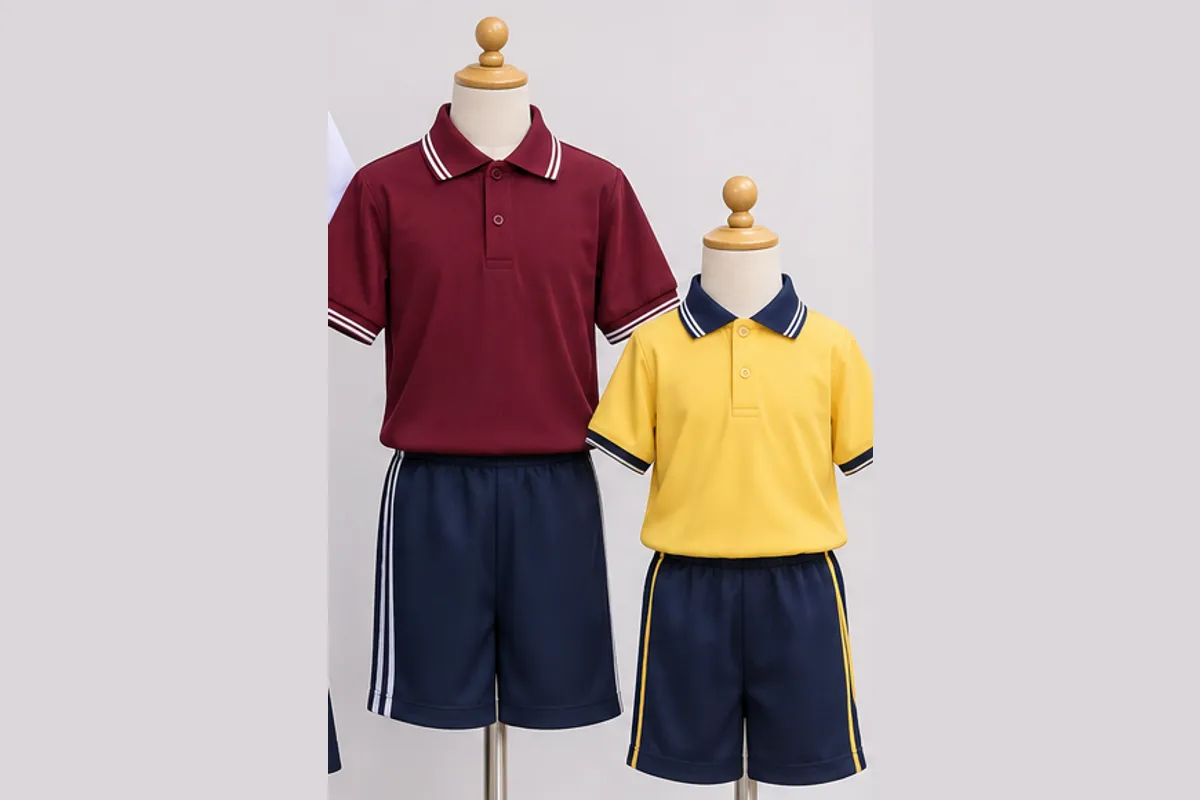
T-shirt twisting after washing happens when the side seams of a knitted tee move round towards the front or back, so the hem looks crooked and the shirt hangs at an angle. It comes from the way single jersey is knitted: the loops have a slight natural lean, and washing lets the fabric relax into it. Careful fabric finishing and cutting reduce twist, and a home wash of the sample shows whether a PE T-shirt is prone to it before you order in bulk.
Families notice twist quickly, and it often leads to complaints that the tee “lost its shape”, so it is worth understanding.
What causes the twist?
The knit itself
Single jersey is knitted on circular machines that feed yarn in a spiral. The loops sit at a very slight angle. In the fabric roll this lean is held in place, but once the garment is washed and the fibres relax, the fabric can settle back into its natural angle. Technically this is called spirality.
The yarn
Yarn is made by twisting fibres together. If that twist is not balanced, it adds to the fabric’s lean. This is one reason two fabrics that look the same can behave differently in the wash.
Cutting
If fabric is laid out and cut slightly off its straight line, the garment pieces start with a small angle built in. Washing then exaggerates it.
How twist shows on a PE T-shirt
| Sign | Where to look |
|---|---|
| Side seam drifts towards the front | Lay the tee flat and follow the seam from underarm to hem |
| Hem no longer level | Hold the tee up by the shoulders |
| Printed logo looks off-centre | Compare the logo with the centre fold |
| Sleeves point in different directions | Lay the tee flat after drying |
| One side of the hem is longer | Measure each side seam |
A small amount of movement is common in knitted tees. What matters is whether it is enough to be noticed when worn.
Does fabric choice matter?
We make PE T-shirts in polyester knit or cotton jersey. In general:
- Cotton jersey is more likely to show twist, especially if the fabric has not been pre-treated to relax it before cutting.
- Polyester knit tends to hold its shape more steadily, though it is not immune.
- Heavier, more tightly knitted fabrics tend to twist less than very light, loose ones.
These are tendencies, not promises about any specific fabric. The sample is the real test.
Checking for twist on the sample
Twist only shows after washing, so a sample fresh from the parcel tells you little. Try this:
- Lay the unwashed sample flat. Mark the bottom of each side seam with a pin or a dot.
- Wash it as a family would, at the care label temperature.
- Dry it naturally, flat or on a line.
- Lay it flat again, aligning the shoulders, and look at where the side seams fall.
- Repeat after two or three more washes.
If the seams have moved enough to bother you, tell us before approving. We can review the fabric or the way it is cut.
Points to raise with your maker
- Ask whether the fabric is relaxed or pre-treated before cutting
- Wash-test the sample several times, not just once
- Check twist on both a small and a large size
- Check printed logos stay centred after washing
- Keep a washed, approved sample to compare with deliveries
Our fabrics and colour matching page explains the fabric options for each garment, and the PE T-shirts and other kit we manufacture in India are on our PE kit and sports uniforms page. Send your preferred fabric or a reference tee, and we will make a sample and quote by fabric, quantity and branding.
Questions buyers ask
Can twisted T-shirts be straightened by ironing?
Ironing can flatten a tee for a while, but the twist usually returns after the next wash because it comes from the fabric itself. Preventing it at the fabric and cutting stage works far better than correcting it later.
Is twist a sign of poor quality?
Not always. Every single jersey fabric has some natural lean. Noticeable twist after a few washes, though, suggests the fabric was not relaxed properly or was cut off-grain, which is worth raising at sample stage.
Do side panels stop a T-shirt twisting?
Side panels change the seam layout, which can make small twist less noticeable, but they do not change how the fabric behaves. The fabric finishing and accurate cutting matter more than the design.