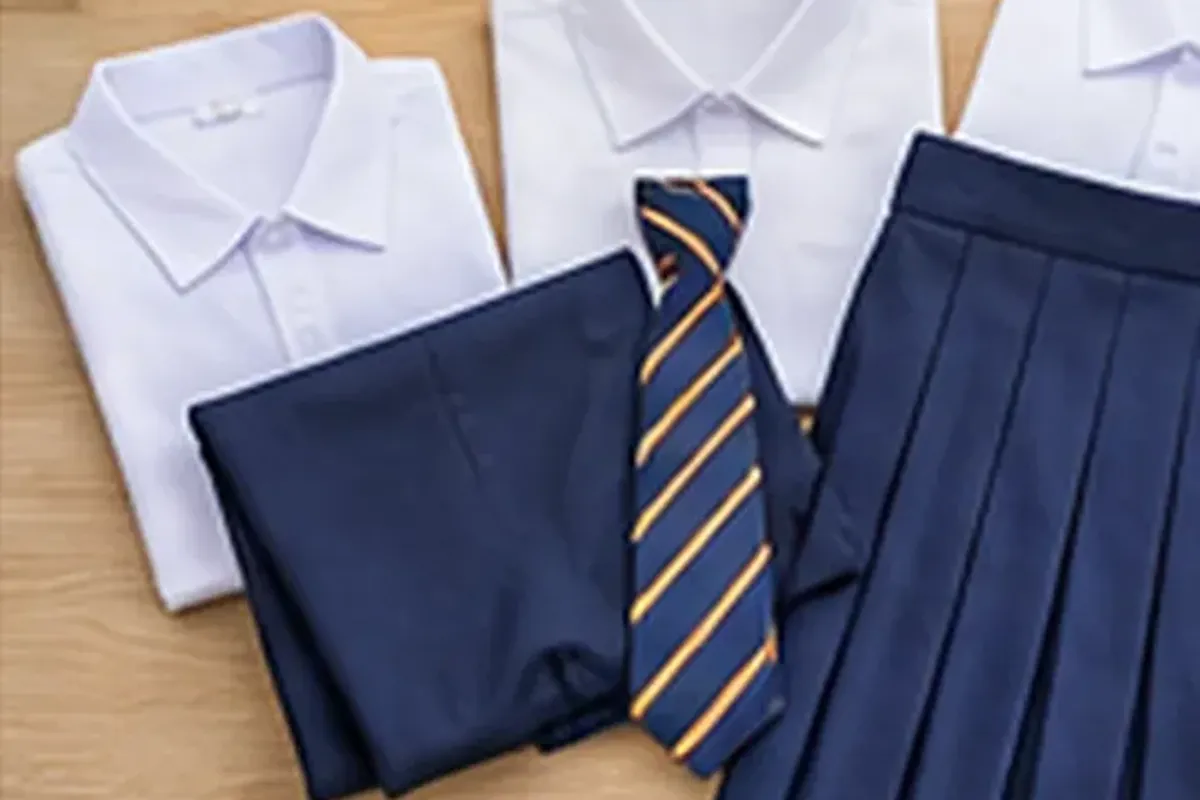
A part pleated school skirt has pleats on one section only, most often the front, with a plain panel at the back or sides. It keeps the pleated look that schools like on the front while making the skirt lighter, quicker to press and easier to fit with an elastic back. To order one, specify which panels are pleated, the pleat type and count on those panels, and how the plain panels are shaped.
Part-pleated skirts sit between a fully pleated skirt and an A-line skirt. They are a common answer when a school wants pleats but families find a fully pleated skirt hard to look after.
Common part-pleated layouts
Several layouts appear regularly on school lists. Each one balances look, comfort and care differently.
| Layout | Pleated area | Plain area | Why buyers choose it |
|---|---|---|---|
| Pleated front panel | Front, side to side | Whole back | Pleated look facing forward; elastic back is easy |
| Front and back panels | Centre front and centre back | Sides | Balanced from both views; smooth over the hips |
| Pleated hem section | Lower part only, below a yoke | Upper skirt (the yoke) | Smooth fit over the hip, swing at the hem |
| Side pleat groups | Two groups at each side front | Centre front and back | Clean centre front with movement at the sides |
The pleated front panel is the most common for junior sizes. The yoke layout, where pleats hang from a fitted band round the hips, suits senior students who want a slimmer line over the hip.
Why choose part pleats over full pleats?
Buyers usually come to part pleats for practical reasons:
- Less pressing. Fewer pleats mean less ironing each week for families.
- Lighter skirt. Fewer folds use less fabric, which also helps in warm classrooms.
- Easier elastic back. A plain back panel takes elastic in the waistband neatly, without bunching pleats together.
- Smoother seat. A plain back sits flat when the student is seated on chairs or benches.
The trade-off is that the skirt looks plainer from behind and has a little less swing than a fully pleated skirt. For most primary schools, that is an easy trade.
Specifying the pleated section
Treat the pleated section as its own small specification:
- Pleat type: knife, box or inverted.
- Number of pleats in that section, and whether it changes by size.
- Width of the section at the waist, in centimetres or as “side seam to side seam”.
- Direction for knife pleats, described from the front.
- Stitched-down length from the waistband or yoke seam.
Shaping the plain panels
The plain back or side panels need their own shaping. On a fixed-waist skirt, a dart or two shapes the back to the body. On an elastic-back skirt, the panel is cut a little wider at the waist and gathered by the elastic. On a yoke skirt, the yoke is cut to fit the hip and the pleats hang from its lower edge. Say which approach you want, or send a skirt to copy.
Fabric and colour
Part-pleated skirts are made in the same fabrics as our other plain skirts, poly-viscose or polyester twill, with the fabric confirmed at quotation. A yarn-dyed check works too, with care taken to line the check up where the pleated section meets the plain panel. Colours are navy, grey, black, bottle green or a shade matched to your reference.
Schools moving from a fully pleated skirt to a part-pleated one can run both side by side for a while, as long as colour and length match. Our page for schools and school groups explains how we work with schools directly, and our school skirts and skorts page lists every style we make.
We are a garment manufacturer in India. Tell us which panels you want pleated and send a sketch or current skirt, and we will come back with a quotation and a sample plan.
Questions buyers ask
Will a part-pleated skirt look different from a fully pleated one in photos?
From the front, very little. The difference shows from behind and when the student walks, because the back stays flat. In group photos taken from the front, a pleated front panel reads almost the same as a fully pleated skirt.
Can the yoke on a part-pleated skirt carry a label or logo?
A woven or printed label sits inside the waistband as usual. An embroidered logo on the yoke is possible but rare on skirts, and its size and position would be confirmed on the sample.
Is a part-pleated skirt suitable for senior students?
Yes, especially the yoke style, which fits smoothly over the hip and lets the pleats swing below. Many senior students find it more comfortable than a fully pleated skirt, and it pairs well with a fixed waistband and side zip.