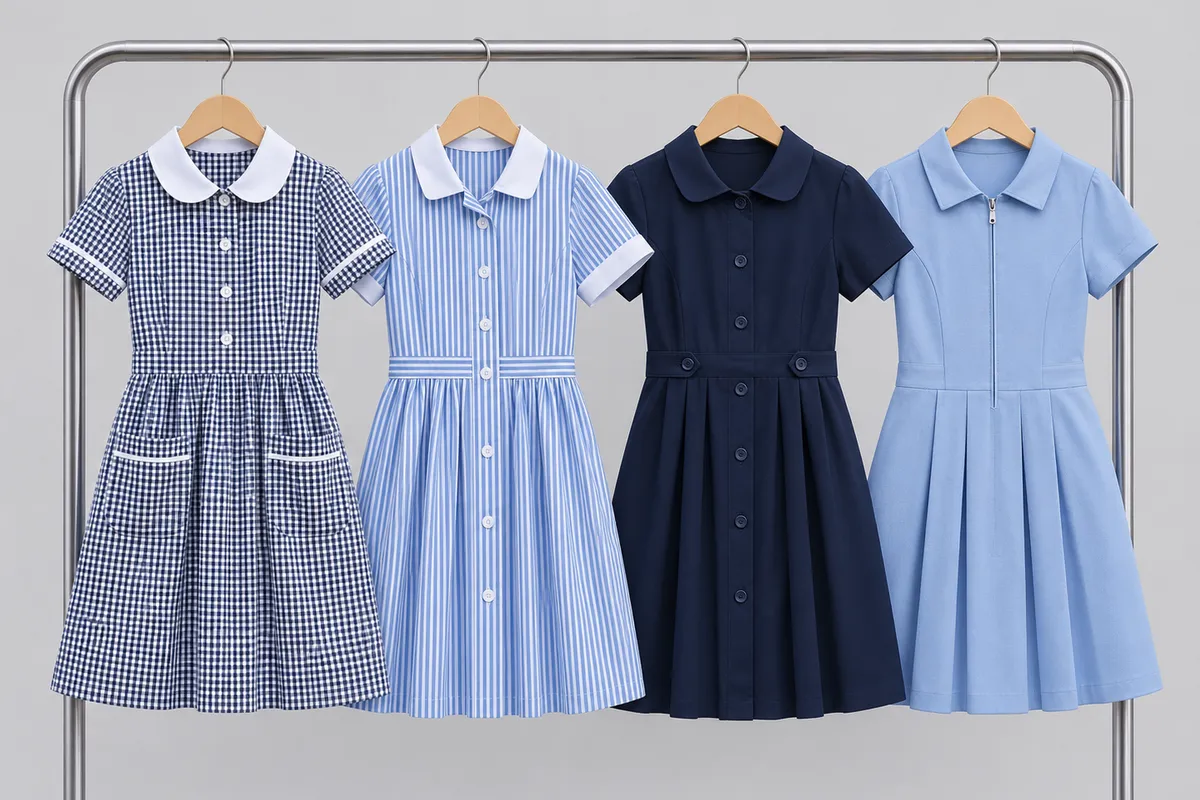
Own label gingham school dresses are plain summer dresses made to a shop’s or supplier’s specification, carrying the seller’s own label rather than a school logo, and sold to every school that uses that gingham colour. The model works because many schools ask only for “a blue gingham dress”, so one well-planned line can serve them all with pooled stock.
This post is for uniform shops and schoolwear suppliers building or reviewing an own-label summer dress line. It covers which colours to run, what goes on the label, and how to plan quantities across schools.
Why own-label dresses suit summer stock
A logo dress belongs to one school. If that school’s numbers fall, or it changes its dress, the stock is stranded. A plain own-label dress can be sold to any school whose list it satisfies. That spreads risk, keeps sizes moving, and makes leftover stock easy to carry into the next summer.
The label also builds the seller’s name. Families who buy the same dress from the same shop each summer associate the quality with the shop, not with an unknown maker.
Choosing which colours to run
Start from the schools you serve and group them by colour. A line with too many colours dilutes stock; a line with too few leaves schools unserved.
| Colour question | What to check | Decision it informs |
|---|---|---|
| Which gingham colours do your schools ask for? | Uniform lists of each school | The core colours of the line |
| Do schools accept a close match, or need an exact shade? | Ask the school, or compare with their current dress | Whether one colour can serve several schools |
| What check size do they expect? | Current dresses or uniform photos | Whether one check size suits all |
| Which colours sell in enough volume? | Last season’s sales | Whether a colour reaches the minimum alone |
Colours that only one small school uses may be better as a separate logo or plain dress for that school, outside the own-label line.
What goes on an own label?
A woven or printed label sewn in at the neck carries your brand. Buyers often add:
- Size, in the same wording the shop uses on its rails.
- Fibre content and care instructions, in the form your market expects. Requirements vary by country, and labelling is confirmed at quotation.
- A style or colour code, so staff can reorder the same line.
- Space for a name, which families appreciate on a school dress.
The label design, position and wording are fixed on the approved sample. Our page for uniform shops and retailers explains how we make own-label stock for shops.
How do you plan quantities across schools?
Own-label stock is pooled, so plan by colour and size across all schools, not school by school.
- List each school using each colour, with an estimate of dresses they will buy.
- Add them together by colour to give the season total.
- Apply one size ratio to each colour’s total, adjusted for any school with an unusual age range.
- Check each colour against the minimum. Each style and colour combination should reach 50 pieces, with sizes mixed.
- Hold back part of the total for a top-up, since pooled demand is easier to read once the season starts.
The larger, pooled quantity makes each size deeper, which reduces sell-outs.
Keeping the line consistent
An own-label line lives or dies on consistency. Families notice if this summer’s blue is not last summer’s blue. Keep a sealed reference dress of each colour, ask for each reorder to be made to the approved sample, and compare the first pieces of each delivery with the reference before stock goes on the shelf.
We manufacture plain gingham dresses in India under buyers’ own labels. The dress styles are on our school summer dresses page. Send us the colours and schools your line will serve, and we will quote per style and colour, by fabric, quantity and branding.
Questions buyers ask
Can a school’s logo be added later to an own-label dress?
A logo can be added locally after delivery, but it is easier to plan logo and plain stock separately. If a school later wants its logo, a separate logo style can be ordered for that school while the plain line continues for others.
Should the own label mention the school?
Usually not, since the point of the line is that it serves several schools. Keep the school name off the label and let the shop’s display and size guide show which schools each colour suits.
What if two schools use slightly different shades of blue gingham?
Compare their current dresses side by side. If the difference is small and both schools agree, one shade can serve both. If not, run two colours, each reaching the minimum on its own.