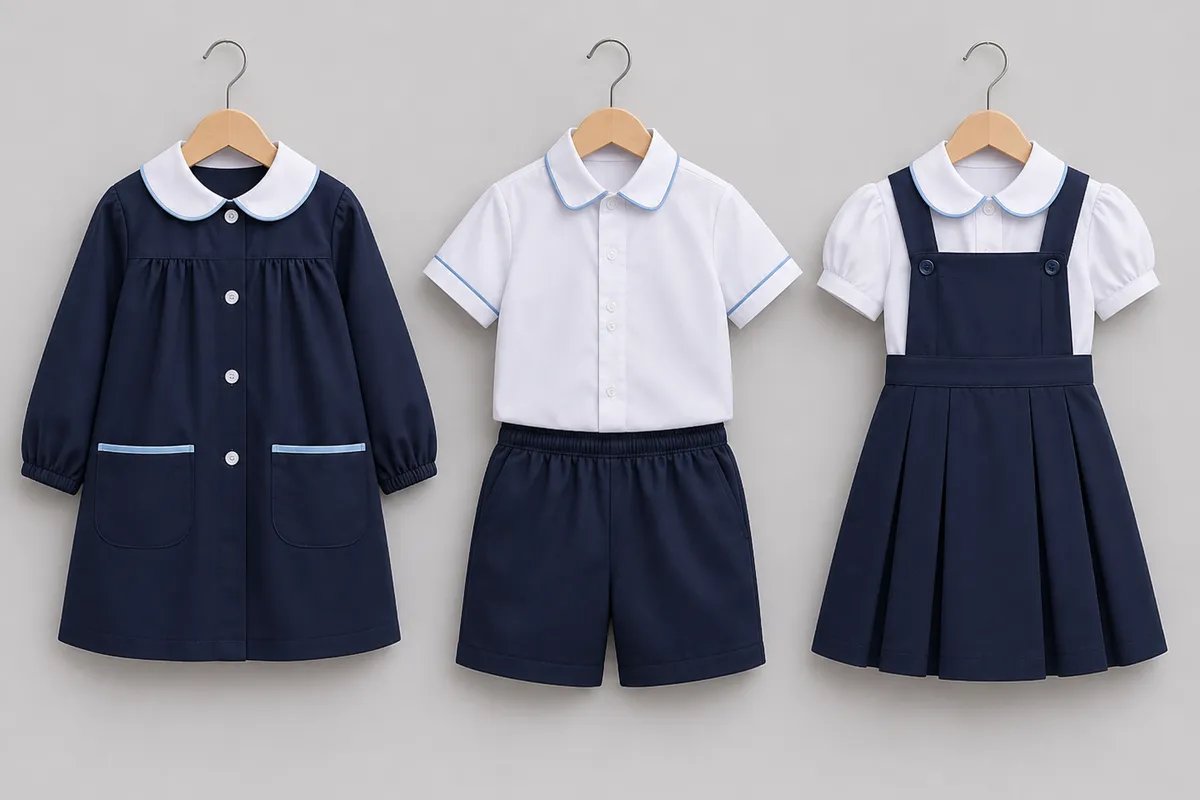
Nursery smock styles differ in four main ways: sleeve length, neckline, body length and where the fastening sits. A short-sleeved, round-necked smock that reaches mid-thigh and fastens at the front is the most common style, but each of those features can be changed to suit the nursery’s climate, activities and look. Choosing them deliberately, rather than accepting a default, gives a smock that children and staff find easy to live with.
A nursery smock is a loose woven overgarment worn on top of a child’s own clothes, cut wide enough to slip on easily and long enough to cover what is underneath.
Sleeve options
| Sleeve | What it is | Suits |
|---|---|---|
| Sleeveless | No sleeve; finished armhole | Very hot climates; tabard-like look |
| Short sleeve | Ends above the elbow | All-year wear in warm places; art tables, where sleeves stay out of paint |
| Three-quarter sleeve | Ends between elbow and wrist | A compromise: some cover, less in the way |
| Long sleeve | Reaches the wrist, open or elasticated | Cooler settings; more cover for messy play |
Sleeve finish matters as much as length. An open hem is simplest; an elastic cuff stops a long sleeve sliding down over the hands. Choose the finish when you choose the length.
Neckline options
The neckline decides how the smock goes on and how it looks.
- Round neck, no collar. Plain and quick to make. Easy to pull over the head if there is a fastening at the front or back.
- Round neck with a flat collar. A small rounded collar, often in a contrast colour, gives a smarter, school-like look.
- Shirt-style collar. Less common on smocks; looks formal but adds pressing and bulk.
- V-neck or wrap. Opens wider, which some nurseries like for quick dressing; shape depends on how the front overlaps.
Whatever the neckline, it should open wide enough for a small head to pass through comfortably once the fastening is undone. That is checked on the sample.
Body length and shape
Smock length is usually described by where the hem falls on the child: hip, mid-thigh or knee.
- Hip length looks neat over shorts and trousers but leaves the lower half of clothes exposed.
- Mid-thigh covers most tops and the top of trousers or skirts; this is the length most nurseries choose.
- Knee length gives the most cover but can catch on climbing frames and steps.
The shape below the chest can be straight, slightly A-line or gathered into a yoke. A gentle A-line gives room to move without extra fabric bunching at the front; a gathered yoke gives a traditional look and more swing.
Fastening position
A smock’s fastening can sit at the front, the back or the shoulder. Fastenings are buttons or press studs, as specified.
- Front opening: a child can see it, and some older nursery children can start to manage it.
- Back opening: harder for the child to undo, which some nurseries prefer during messy play; staff fasten it.
- Shoulder opening: keeps the front clean for a logo and suits a round neck.
The number of fastenings, and the gap between them, is settled on the sample.
Putting a smock style together
A clear smock specification combines one choice from each heading:
- Sleeve length and sleeve finish
- Neckline and collar, with any contrast colour
- Body length and shape
- Fastening position and type
- Pockets, if any
- Logo position, if any
- Fabric: poly-cotton or cotton
- Colour reference
Our smock is listed in sizes from age 2–3 to 5–6, and the size chart is agreed for each order. The minimum is 50 pieces per style; a long-sleeved and a short-sleeved version count as two styles. See the smock and the other nursery styles on our nursery and kindergarten uniforms page, and if you supply several nurseries, read how we work for schoolwear suppliers and distributors.
We manufacture smocks in India to each buyer’s style. If you already use a smock you like, send one and we will copy its style; if you are starting fresh, send the choices from the checklist and we will quote and sample it.
Questions buyers ask
Which smock style is easiest for staff to put on a child quickly?
A front or shoulder opening with a few fastenings and a roomy neckline is usually quickest for staff. Short sleeves also help, because there is no cuff to work over the hand. Test the speed on the sample with a member of staff.
Can one smock style be made in two sleeve lengths?
Yes, but each sleeve length is treated as its own style for the minimum order. Some nurseries order short sleeves for most of the year and a smaller quantity of long sleeves for cooler months.
Does a gathered yoke smock take more fabric?
A gathered yoke uses more fabric across the body than a straight or A-line cut, which can affect the quotation. It also gives a fuller look. If you want a simpler, plainer smock, a straight or gently flared cut is the usual choice.