Kindergarten, nursery and preschool all describe education before formal school, but the age each word covers changes from country to country. A kindergarten in one country is a five-year-old’s first school year; in another it is a three-year-old’s playgroup. For a uniform order, the safe approach is to give the ages in each class alongside its name, because the ages decide the sizes and the names do not.
What do the main early years terms mean?
These short definitions cover the words trade buyers most often use in enquiries.
- Nursery is care and early education for children before school, often from two or three. In some countries it also means the setting itself, such as a day nursery.
- Preschool is a general word for the year or years before school. It can be a setting or a class.
- Kindergarten ranges from a pre-school setting for three- to five-year-olds to the first year of primary school, depending on the country.
- KG is short for kindergarten, often used with numbers: KG1, KG2.
- LKG and UKG stand for lower and upper kindergarten, two years before Class 1.
- Pre-K means pre-kindergarten, the year before kindergarten in American usage.
- Reception is the first class of primary school in England and some other places, for four- to five-year-olds.
- Pre-primary is used in several countries for the years before Grade 1.
- Early years is a general term for this whole stage.
How the same age is named in different places
The table shows how one age group, roughly four-year-olds at the start of the year, is commonly named. It is a general guide; individual schools may differ.
| Where the buyer is | A common name for four-year-olds | The next year is called |
|---|---|---|
| England | Nursery class or pre-school | Reception |
| USA | Pre-K | Kindergarten |
| Indian-curriculum schools, at home or abroad | LKG or KG1 | UKG or KG2 |
| British-curriculum international schools | FS1 | FS2 |
| Australia (varies by state) | Kindy or pre-school | Kindergarten, Prep, Reception or Pre-primary |
| South Africa | Grade RR or pre-school | Grade R |
| Kenya | PP1 | PP2 |
| Singapore | Nursery 2 | K1 |
The same word can sit in different rows. “Kindergarten” appears as both a pre-school year and a school year in this table, which is exactly why ages matter more than names.
Why the name matters less than the age for a uniform order
A uniform maker cannot size an order from a class name. Two problems come up often:
- Same name, different ages. An American kindergarten class is about a year older than a KG1 class elsewhere, so the sizes differ.
- Different names, same children. A distributor supplying schools in two countries may receive FS2 and UKG orders that are, in practice, the same age group and could share a size plan.
Giving ages alongside names solves both. It also helps when one design is sold to several kinds of setting, since the size split can be planned once by age and labelled for each buyer.
Writing an early years enquiry that sizes correctly
When you send an enquiry for nursery or kindergarten uniform, include:
- The name each school uses for each class
- The age range of children in each class at the start of the year
- Number of children per class
- The month the school year starts
- Which garments each class wears
- Any class names you want printed on carton labels
If you supply schools in more than one country, our page for schoolwear suppliers and distributors explains how we handle orders that cover many schools. The garments are on our nursery and kindergarten uniforms page. Send us your class names with ages, and we will plan the size split with you in the quotation.
Questions buyers ask
Is a nursery uniform different from a kindergarten uniform?
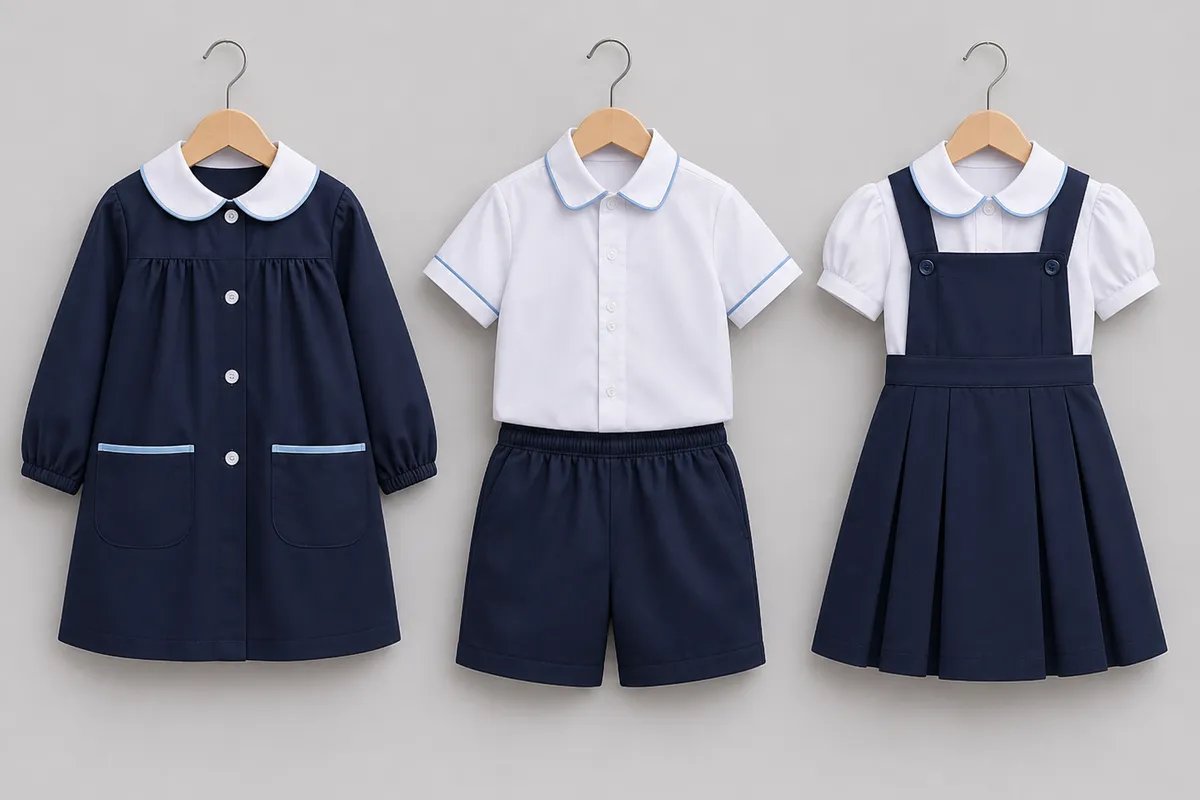
Often the garments are the same kinds of piece: smocks, shirt-and-shorts sets and pinafore sets. What changes is the size range and sometimes the design, as older kindergarten children may wear something closer to the school uniform.
Can one design be sold as nursery uniform in one country and kindergarten uniform in another?
Yes. The garment does not change, only the description and perhaps the label. A distributor can order one design and use different product names in each market.
What age range should a carton label show?
Show the age band of the garments inside, such as 4–5, rather than a class name. Age bands mean the same thing to everyone handling the stock, wherever it is unpacked.