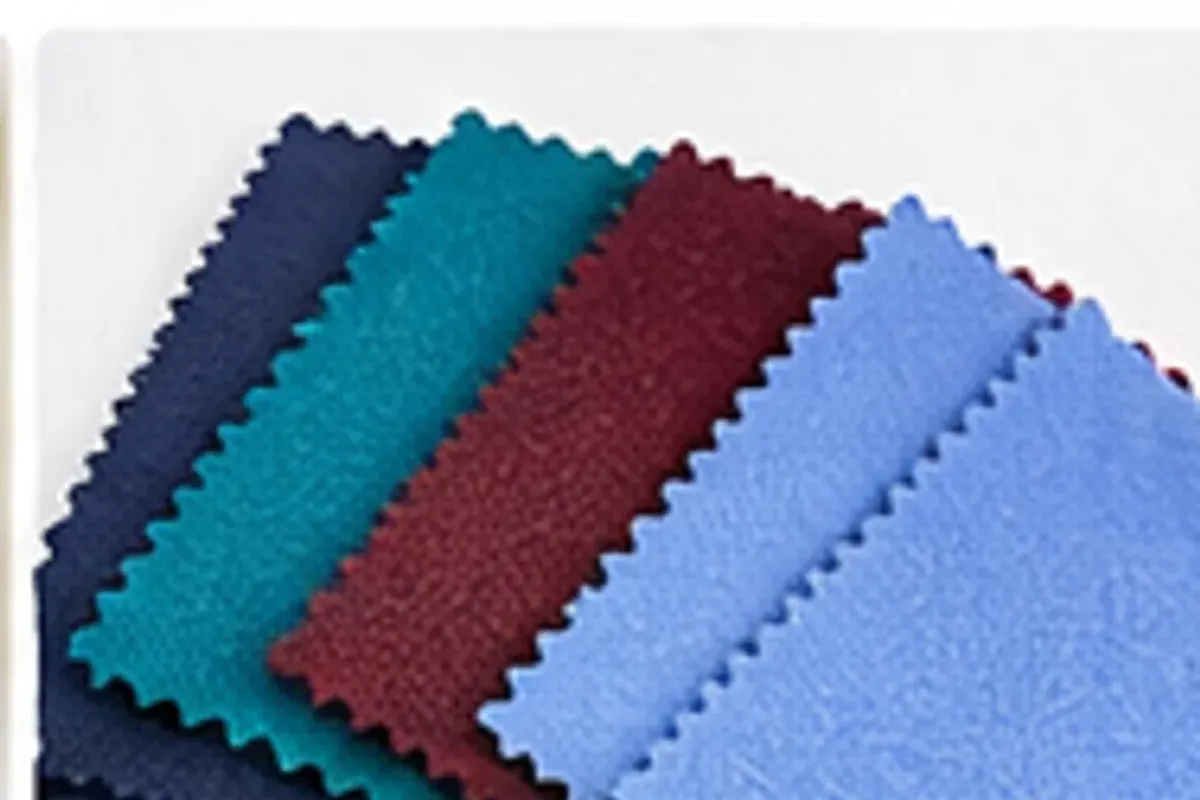
Matching uniform colour across fabrics means getting a woven blazer, a knitted jumper and a piqué polo to read as the same shade, even though each fabric takes dye differently. It is done by matching every fabric to one master reference, approving the samples side by side in daylight, and accepting that the aim is a visual match rather than identical dye readings.
A school says “our colour is bottle green”, but that green has to appear on cloth, yarn and jersey. If it drifts between them, the uniform looks assembled from different sources, even when every piece is new.
Why the same colour looks different on different fabrics
Three things change how a colour appears once it is on a garment.
- Fibre. Polyester, viscose, cotton and acrylic each absorb dye in their own way. A blend such as poly-viscose or poly-cotton holds two fibres, both of which have to be coloured.
- Construction. A tight woven twill reflects light differently from a loose knit or a textured piqué. Knitted surfaces often look slightly softer and lighter than woven ones of the same dye.
- Finish. Brushing, as on the inside of a sweatshirt fleece, or a smooth pressed finish on a blazer, changes how much light bounces back.
The result is that two garments dyed to the same recipe will not always match by eye, and two garments that match by eye may have quite different recipes.
Which garments sit together in a uniform?
The pairs that matter most are the ones worn next to each other every day.
| Pairing | Woven or knitted | Why it matters | What to check |
|---|---|---|---|
| Blazer and jumper | Woven and knitted | Jumper shows at the blazer’s V and cuffs | Shade at the neckline and sleeve ends |
| Skirt and cardigan | Woven and knitted | Worn together all winter | Overall tone at arm’s length |
| Pinafore and jumper | Woven and knitted | Jumper sleeves sit against the bodice | Shade side by side |
| Trousers and sweatshirt | Woven and knitted | Often both navy or grey | Depth of colour |
| Polo and summer dress | Knitted and woven | Same school colour in summer | Brightness of the tint |
| Tracksuit and PE shorts | Knitted and knitted | Different knits, same colour | Shade and sheen |
Our page on fabrics and colour matching explains that woven and knitted fabrics are matched separately, which is why each pairing is approved on its own sample.
How to approve one shade across many fabrics
The method is simple, but every step matters.
Fix a single master reference
Choose one physical reference for the colour: usually the garment that families see most, such as the blazer or jumper. Every other fabric is matched to that, not to each other. If you match the skirt to the jumper and the polo to the skirt, small differences add up.
Approve under more than one light
Look at the samples in daylight by a window, then under ordinary indoor lighting. Some colours look matched in one light and different in another. If the pair holds in both, it will hold in a classroom and a playground.
Look from a distance
Hold the garments together at arm’s length and then from a few metres away. That is how they will be seen. Tiny differences at close range often disappear at a normal viewing distance.
Keep the approved pieces
Once you approve the shades, keep a cutting of each approved fabric. It is the reference for every reorder.
- One master reference chosen for each school colour
- Each woven and knitted fabric matched to the master, not to each other
- Samples checked in daylight and indoor light
- Samples checked side by side at a normal viewing distance
- Approved cuttings stored for reorders
What a realistic match looks like
Buyers sometimes expect a woven and a knitted garment to be identical. A realistic goal is that they look like the same colour when worn together. A slightly softer tone on a knit is normal and accepted on most uniforms. A clear difference in hue, such as one navy leaning purple and the other leaning green, is not, and should be corrected before production.
When you send your uniform list, tell us which garment is your master colour. We will match each style to it, show you the shades together on the samples, and quote each style, from knitted jumpers and cardigans to blazers, by fabric, quantity and branding.
Questions buyers ask
Can a knitted jumper ever exactly match a woven blazer?
They can look the same colour at a normal viewing distance, which is what matters on a uniform. Up close, the knit’s texture usually makes it read slightly softer. A difference in hue, rather than texture, should be corrected before bulk production.
Which garment should be the master colour reference?
Choose the garment that most defines the school’s look, usually the blazer, jumper or sweatshirt. Match every other fabric to that piece, so the whole uniform centres on one colour instead of drifting through a chain of near matches.
Does a poly-cotton polo hold colour differently from a polyester one?
Yes. Blends have two fibres that take dye in different ways, while a single fibre takes it more evenly. Both can be matched to the same reference, but each is approved on its own sample before the bulk order is made.