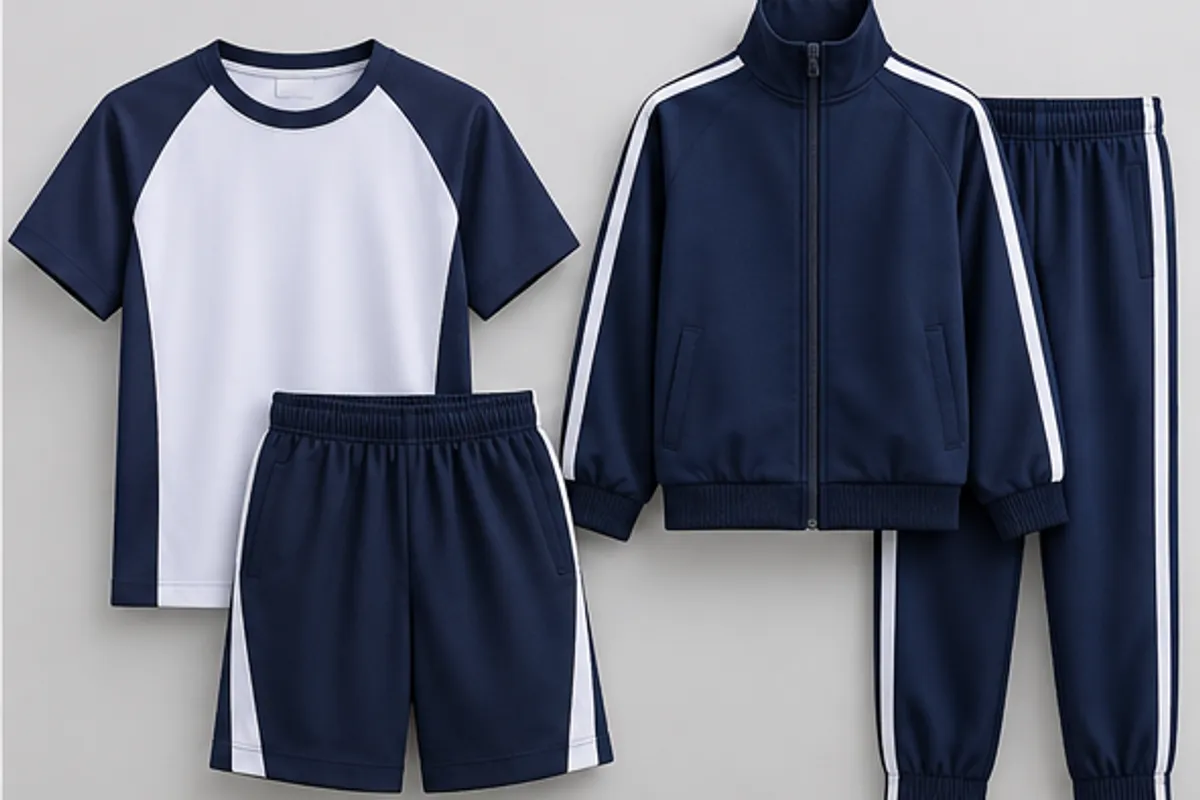
To measure for a school tracksuit, take four body measurements: chest for the top, then waist, hip and inside leg for the bottoms. Measure over a thin T-shirt or polo, keep the tape level and snug but not tight, and write each number down in centimetres before you look at any size chart.
A tracksuit is two garments that fit in different ways, so one “size” guessed from a student’s age is rarely enough. The method below suits a uniform shop sizing students at the counter, a school collecting sizes for a sports squad, or a supplier building its own measurement chart.
Which measurements does a tracksuit need?
Each piece of the tracksuit depends on its own set of measurements. The top hangs from the shoulders and is judged mainly by the chest. The bottoms sit on an elastic waist, so the waist gives a range rather than a single answer, and the inside leg decides whether the hem lands at the ankle.
| Measurement | Where to take it | Used for |
|---|---|---|
| Chest | Around the fullest part, under the arms, tape level across the back | Tracksuit top and fleece jacket size |
| Waist | Around the natural waist, at or just above the navel | Tracksuit bottoms, elastic range |
| Hip | Around the widest part of the seat | Bottoms, especially for older students |
| Inside leg | From the crotch to the floor along the inner leg, without shoes | Leg length of the bottoms |
| Height | Standing straight against a wall, without shoes | A cross-check against age sizes |
Height is not strictly needed, but it is a quick check. A child who is tall for their age will often need a longer leg than the age size suggests, even when the waist fits.
How to take each measurement correctly
Work with the student standing relaxed, arms by their sides, feet slightly apart. A second person to read the tape helps with younger children.
- Chest. Pass the tape under the arms and around the back. Check in a mirror, or ask a colleague, that it has not slipped down at the back. Ask the student to breathe normally.
- Waist. Find the narrowest point of the body, or where the student wears their trousers if that is clearly lower. Tracksuit bottoms usually sit where everyday trousers sit.
- Hip. Measure around the fullest part of the seat with the feet together.
- Inside leg. Hold the end of the tape at the crotch and run it straight down the inner leg to the floor. If the student is wearing shoes, take them off; a heel adds length that the hem does not need.
Round each figure to the nearest half centimetre. Record it on a simple form with the student’s name, year group and the date, because children grow fast and an old measurement can mislead a later order.
From body measurements to a tracksuit size
A body measurement is not the same as a garment measurement. A tracksuit top with a 70 cm chest on the garment is meant for a smaller body chest, because sportswear is cut with ease for movement and for a layer underneath. Your size chart should say clearly whether its figures are body or garment measurements.
When a student falls between two sizes, these rules help:
- Top: go up a size if the student will wear a sweatshirt beneath it in winter, or if they are growing quickly.
- Bottoms: choose by inside leg first, then check the waist sits within the elastic range. A slightly loose waist can be drawn in with the cord, if the bottoms have one; a short leg cannot be fixed.
- Fleece jacket: size it against the top, not against the bare chest, since it goes over everything.
Our size charts page explains how a chart is agreed for each order, and the school tracksuits and jackets page lists the tops, bottoms and fleece jackets we make. Sizes can be mixed within a style, so a measured list converts directly into a size mix for the order.
Recording measurements for a whole group
Shops and schools measuring many students at once should agree a routine. Use one tape, check it against a ruler at the start of the day, and keep the same person measuring where possible. Different people pull a tape with different tension.
- Same tape and same measurer for the session
- Students measured over a thin top, shoes off
- Chest, waist, hip and inside leg written in centimetres
- Size chosen for top and bottoms separately
- Sheet kept and dated for the next order
If you are planning a tracksuit order and have measurements or a size list ready, send them with your colours and logo and we will prepare a quotation per style, by fabric, quantity and branding.
Questions buyers ask
Should students be measured in their PE kit?
A thin T-shirt or polo is ideal, since that is what most students wear under a tracksuit top. Avoid measuring over a jumper or a coat, which can add several centimetres to the chest and push the student into a size that is too large.
Can one person measure a whole class quickly?
Yes, with a set order and a printed form. Taking chest, waist and inside leg only, a practised measurer can work through a class in one lesson, and hip can be added for older students whose seat measurement often decides the bottoms size.
Do we need measurements for every student, or is age enough?
Age sizes work for most younger students, and many shops sell by age alone. Measuring is worth doing for squads, for older students moving into adult sizes, and for anyone who is unusually tall or slim for their year group.