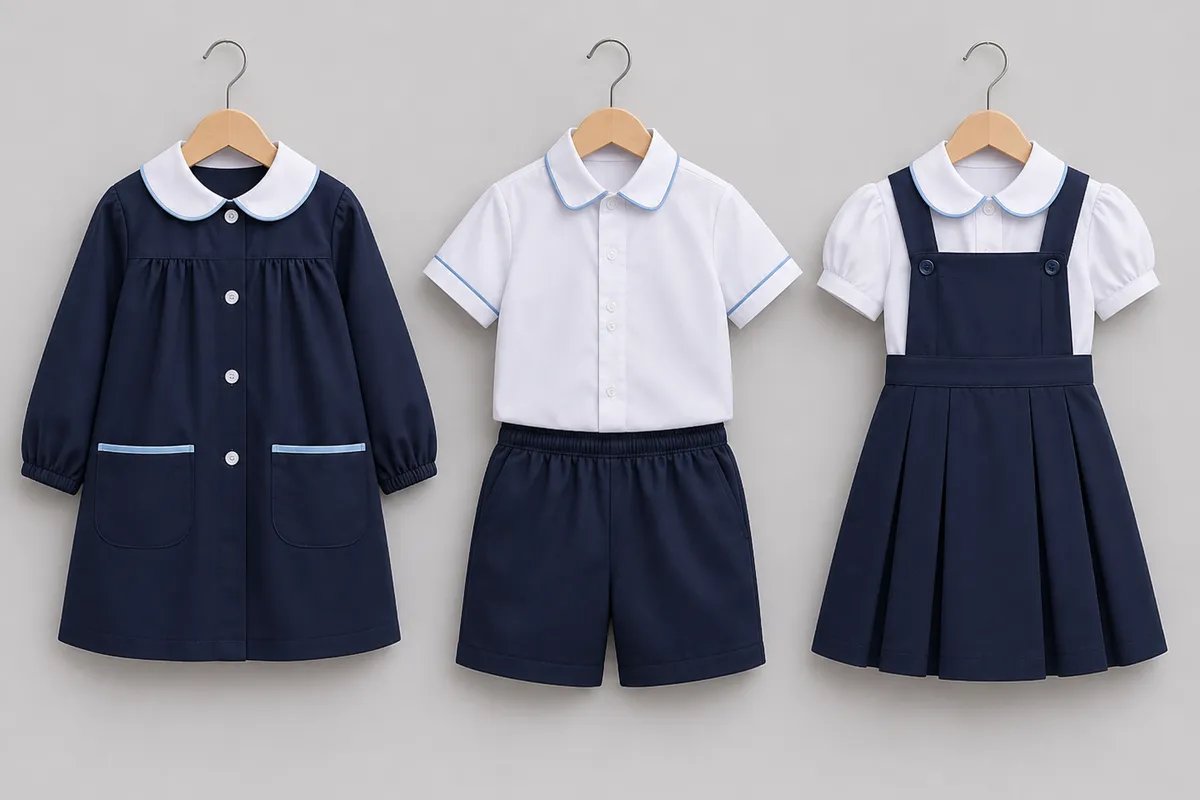
How many nursery uniforms per child you plan for depends mainly on how many days a week the child attends and how often the uniform is washed. As a rule of thumb, a child in nursery every day needs at least three sets of the main garment, and a child attending two or three days needs two. Smocks, which get the messiest, are often planned at a higher number than the sets underneath them.
Why do nursery children need more sets than older pupils?
An older pupil might manage a week with two shirts. A nursery child rarely can, for reasons any room leader will recognise.
- Spills and paint. Meals, painting and water play mark clothes every day.
- Toilet accidents. Children still learning to use the toilet may need a change during the day.
- Outdoor play. Mud and wet grass on the knees are normal.
- Daily washing. Many families wash nursery clothes after every wear, so a set is in the wash as often as it is worn.
A family that buys too few sets ends up sending children in their own clothes, which defeats the point of a uniform for the setting.
Sets per child by attendance pattern
The table is a planning example to adapt to your own families and climate. It assumes uniform is washed after each day worn.
| Attendance | Shirt-and-shorts or pinafore sets | Smocks | Notes |
|---|---|---|---|
| Five days a week | 3 | 3 to 4 | One on, one in the wash, one ready; extra smocks for messy days |
| Three or four days | 2 to 3 | 2 to 3 | Two sets work if washing is reliable mid-week |
| One or two days | 2 | 2 | A spare in the bag covers an accident |
| Mornings only | 2 | 2 | Fewer meals in the setting means fewer spills |
In hot climates, where clothes are changed more often, add one to each figure. In settings where the nursery owns the smocks and keeps them on site, the family figure for smocks drops to zero and the nursery holds its own pool instead.
From sets per child to an order quantity
Once you have a figure per child, turning it into an order is straightforward. Take a nursery with 60 children: 40 full-time and 20 attending two days.
- Full-time children at 3 sets each gives 120 sets.
- Two-day children at 2 sets each gives 40 sets.
- Total sets needed across the year: 160.
- Not every family buys the full number at once, so estimate the share bought on the first day. A shop or nursery with sales records should use those; without them, plan for a first issue and a top-up.
For woven nursery styles the minimum is 50 pieces per style, with sizes mixed, so a first issue of 160 sets is well above it. Smaller settings may need to combine sizes or colours to reach the minimum, or order the full year’s quantity at once.
Who buys the sets: nursery or families?
The answer changes how you plan.
- The nursery issues uniform, perhaps included in fees. It controls the number per child and can order exactly. It should also hold spares for accidents.
- Families buy from a shop or the nursery office. The nursery recommends a number per child, but actual buying varies. The shop plans stock on expected sales rather than on the recommendation.
- A mix. Some nurseries give each child one set on joining and let families buy more. The order covers the issue set plus stock for extra sales.
If you are a school or nursery planning the recommendation, our page for schools and school groups explains how we work with settings that order direct. The garments themselves are on our nursery and kindergarten uniforms page.
Tell us how many children you have, how many days they attend and who buys the uniform, and we will prepare a quotation per style, by fabric, quantity and branding.
Questions buyers ask
Should we tell families exactly how many sets to buy?
A clear recommendation helps, such as “three sets for full-time children”. Families can then plan their spending and the nursery avoids children arriving in their own clothes. Put the figure on the uniform list and the joining pack.
Do children need as many smocks as sets?
Often more, if smocks go home each day and are worn over the set for painting and meals. If the nursery keeps smocks on site and washes them itself, families do not need to buy smocks at all.
Does the number of sets change between summer and winter?
It can. In warm weather children may change more often, and in a climate with a winter uniform the summer sets may be worn less. Plan each season’s sets separately if your uniform changes with the weather.