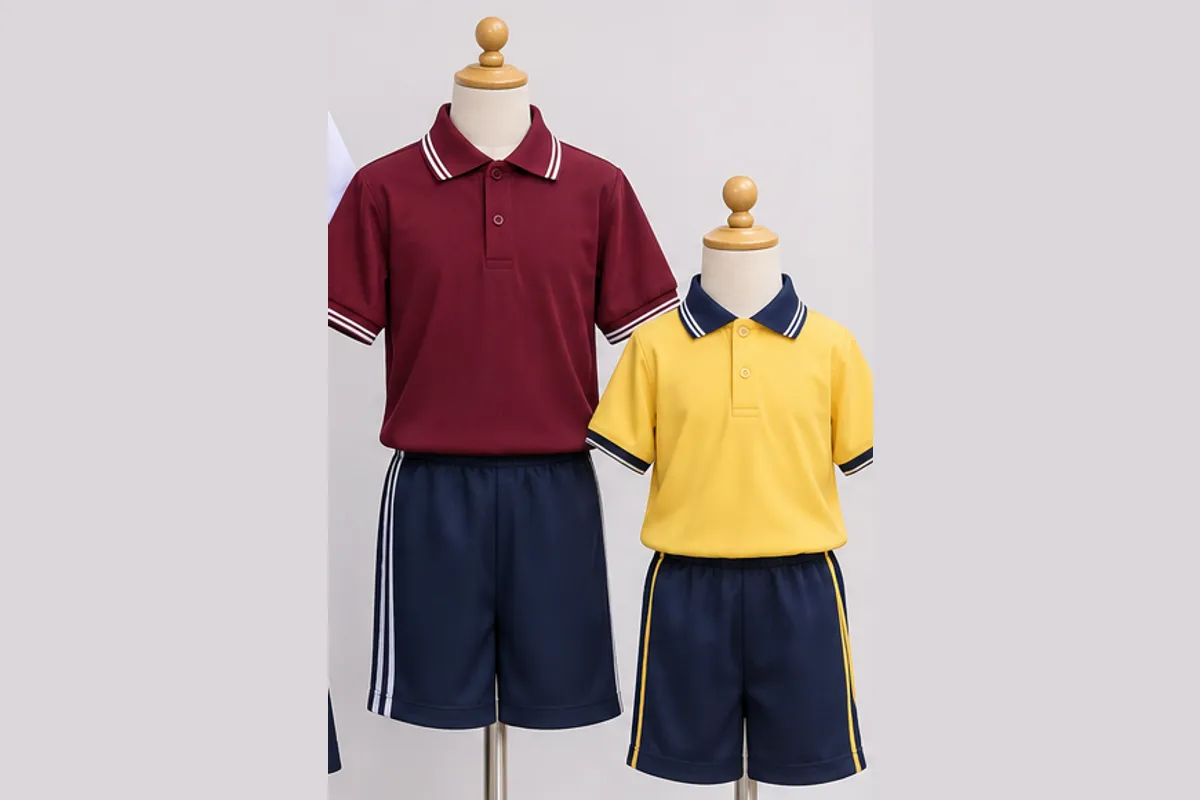
Most students need one full PE kit, plus a second T-shirt if they have PE more than twice a week or the kit cannot be washed between lessons. Shorts last longer and usually stay at one pair. House tops and sports polos are extra garments on top of that, needed only where the school uses them.
For a buyer, the answer turns directly into a multiplier. The number of students on the roll, times the sets each one buys, gives the base quantity for every PE style. Getting that multiplier wrong by even half a set changes a whole order.
The usual number of sets by garment
PE kit is not one garment, so it does not have one answer. Each piece wears and washes differently.
| Garment | Typical number per student | Raise it when | Lower it when |
|---|---|---|---|
| PE T-shirt | 1 to 2 | PE several times a week, hot climate | PE once a week, kit washed at school |
| PE shorts | 1 | Shorts worn for after-school clubs too | Rarely lower |
| House-colour T-shirt | 1 | House top is also the everyday PE top | House events only |
| Sports polo | 0 to 1 | Student plays for a school team | Polo used only by squads |
These are planning figures for a starting point. Your own sales or issue records will show the real number for each school within a year.
What pushes the number up?
Several things lead families or schools to buy a second set, and a buyer can usually spot them in advance.
- Frequency of PE. A school with PE on three days a week cannot rely on one T-shirt being washed and dried in between.
- Climate. In hot or humid places, kit is washed after every wear. Two T-shirts become the norm.
- PE days and uniform days. Some schools let students come to school in PE kit on PE days. That kit is worn all day and washed more often.
- Boarding. Residential students depend on a laundry cycle, and spares are needed while kit is away.
- Clubs and fixtures. Students in teams wear PE kit far more than those who are not.
What pulls it down?
The number falls when kit is worn less or kept at school.
- PE once a week. One set is enough if the kit goes home and comes back washed.
- School-held kit. Some primary schools keep PE bags in the classroom. One set per pupil, plus a few spares held by the class teacher.
- Charity or programme supply. Programmes often fund one set per student, prioritising reach over spares.
Turning sets per student into an order
Once you know the sets per student, the calculation is simple. Here it is for a school of 420 students as an illustrative example:
- PE T-shirts: 420 students, one and a half each on average, gives 630.
- PE shorts: 420 students, one each, gives 420.
- House-colour T-shirts: four houses averaging 105 students, one each, gives about 105 per colour.
- Sports polos: squad players only, perhaps 120 across all teams.
Then apply the size split to each figure, and add spares. “One and a half each” is a real planning figure: it means roughly half of families buy a second T-shirt. If you run a shop, your sales records will tell you the real share within a term or two.
A checklist for confirming the figure with the school:
- How many PE lessons does each year group have a week?
- Do students change at school or arrive in PE kit?
- Is the house T-shirt worn every lesson or only for events?
- Are any teams issued their own polos or shirts?
- Is kit kept at school or taken home to wash?
Our uniform shops and retailers page explains how shops place repeat orders once their sets per student settle.
With your roll and sets per student worked out, send the figures for a quotation on PE kit and sports uniforms. We manufacture in India and quote per style, by fabric, quantity and branding.
Questions buyers ask
Should a school recommend a number of PE T-shirts to families?
Many schools give a suggested list, for example one or two PE T-shirts and one pair of shorts. A clear recommendation helps the shop plan stock, because families tend to follow it closely in the first weeks of term.
Do younger students need more PE kit than older ones?
Younger students often get muddier and may need a spare T-shirt, while older students wear kit harder in competitive sport. The overall number per student is similar, but the reasons differ, so check both with the school.
How do spares differ from a second set per student?
A second set belongs to the student. Spares are held by the school or shop for joiners, lost kit and accidents. Plan both separately, because spares follow the whole school’s needs rather than each family’s choice.