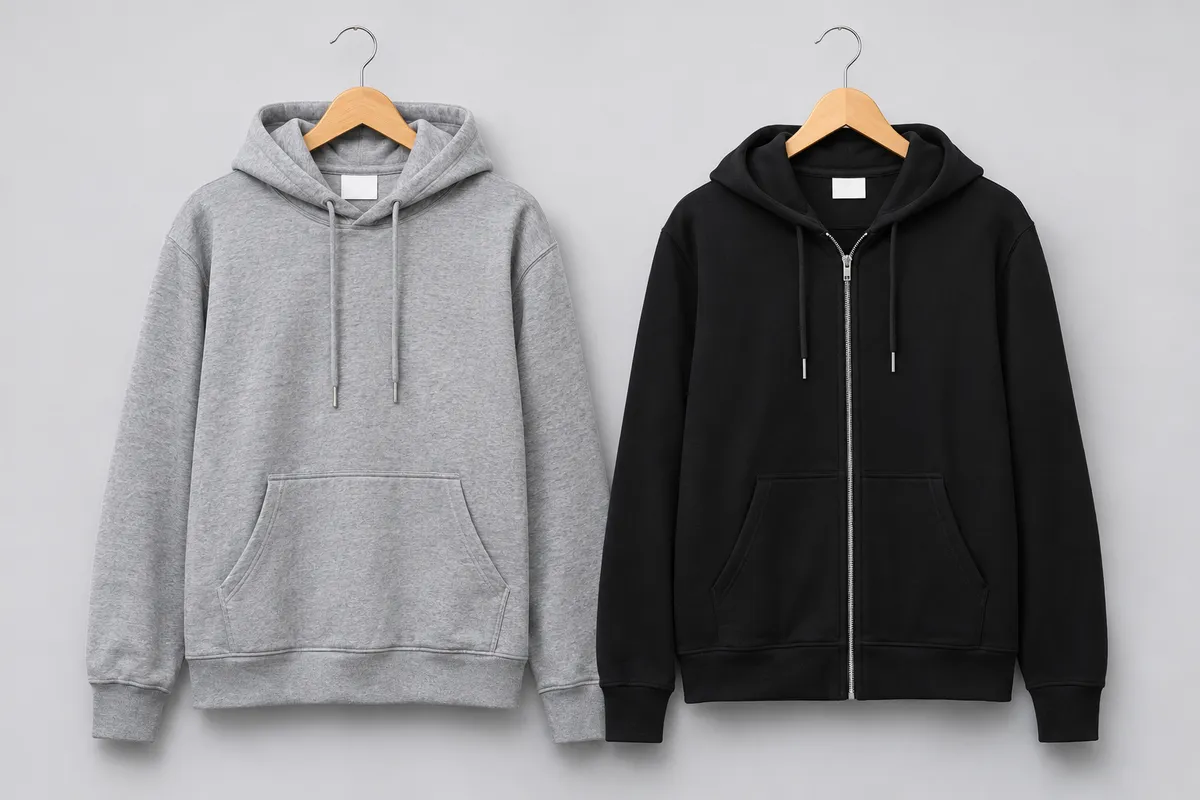
A hoodie is made by cutting fleece into separate pieces, the body, sleeves, hood, pocket and ribbed bands, then decorating and sewing them together in a set order before the finished garment is checked and packed. Most of the quality is decided at three points: how accurately the pieces are cut, how the hood is joined at the neck, and how evenly the ribs are attached. Knowing the sequence helps a buyer understand what the sample shows and why changes after approval are hard to make.
This post walks through the process for a typical pullover leavers’ hoodie. Details vary with the specification, but the sequence is broadly the same.
What pieces make up a hoodie?
| Piece | How many | Notes |
|---|---|---|
| Front body | 1 | Carries the chest print or badge and the pocket |
| Back body | 1 | Carries the main back design |
| Sleeves | 2 | Set-in or raglan, as specified |
| Hood panels | 2 or 3 | Doubled if the hood is lined |
| 1 | Kangaroo or split pouch, if specified | |
| Cuff ribs | 2 | Knitted rib, cut to length |
| Hem rib | 1 | Knitted rib, cut to length |
| Labels and tapes | Several | Neck label, size label, care label, neck tape |
A lined three-panel hood alone can be six pieces, which is why the hood takes more care than its size suggests.
The making sequence, step by step
- Fabric check. The fleece is inspected for colour against the approved reference and for flaws before cutting.
- Cutting. Pieces are cut from layers of fleece using patterns for each size. Cutting along the grain of the knit keeps seams from twisting after washing.
- Decoration. Prints or badges are often applied to the flat front, back or sleeve panels before sewing, when the fabric lies flat. Some decoration is done on the finished hoodie instead. Either way it is matched to the approved proof or sample.
- Pocket. The pocket edges are finished and the pouch is stitched to the front body, with reinforcement at the top corners.
- Shoulders. Front and back are joined at the shoulders, often with a tape for stability.
- Hood. Hood panels are joined, the lining attached if specified, the front edge finished, and any drawcord channel and eyelets added.
- Hood to body. The hood is sewn into the neckline and the inside seam covered with a tape. This is the most visible join on the garment.
- Sleeves. Sleeves are sewn into the armholes.
- Side seams. Each side is sewn in one line from cuff to hem.
- Ribs. Cuff and hem ribs are joined into rings, stretched evenly and sewn on.
- Labels. The neck, size and care labels are sewn in, unless a printed neck mark is used.
- Trimming and inspection. Loose threads are removed and each hoodie is checked against the approved sample.
- Folding and packing as agreed, by size, class or name.
Why changes after approval are difficult
Look at the sequence and you can see why. The pattern for each size is set before cutting. Decoration is often applied to flat panels. The hood is built before it meets the body. Once fleece has been cut and printed, changing the hood shape, the pocket or the print position means starting again with new fabric.
That is why the sample matters so much, and why we ask you to raise every change before you approve it.
What the buyer sees, and what to check
- Pieces cut straight: no twisting down sleeves or sides.
- Prints aligned on the panels and centred on the finished back.
- Pocket corners reinforced.
- Hood join smooth inside, with a neat tape.
- Ribs evenly stretched with no puckers.
- Labels straight and in the agreed position.
The colour of the fleece is checked at the first step, so the reference you send matters. Our fabrics and colour matching page explains what to send.
We manufacture in India and follow this sequence for every hoodie order, with a quality check before dispatch. Send your design and specification, and we will quote your leavers’ hoodies and make a sample for you to inspect.
Questions buyers ask
Why are prints usually applied before the hoodie is sewn?
A flat panel is easier to print accurately than a finished garment, which has seams, a pocket and a hood in the way. Printing first also allows each panel to be checked before sewing. Some designs are printed afterwards when position requires it.
Does a lined hood take longer to make?
Yes, slightly. A lined hood has more pieces and an extra stage of sewing and turning before it is joined to the body. It is a normal part of production and is reflected in the quotation.
Are sweatshirts made in the same way?
Very similarly. A crew-neck sweatshirt follows the same sequence without the hood and pocket, with a neck rib sewn in at step seven instead. Cardigans add the front band and fastenings.