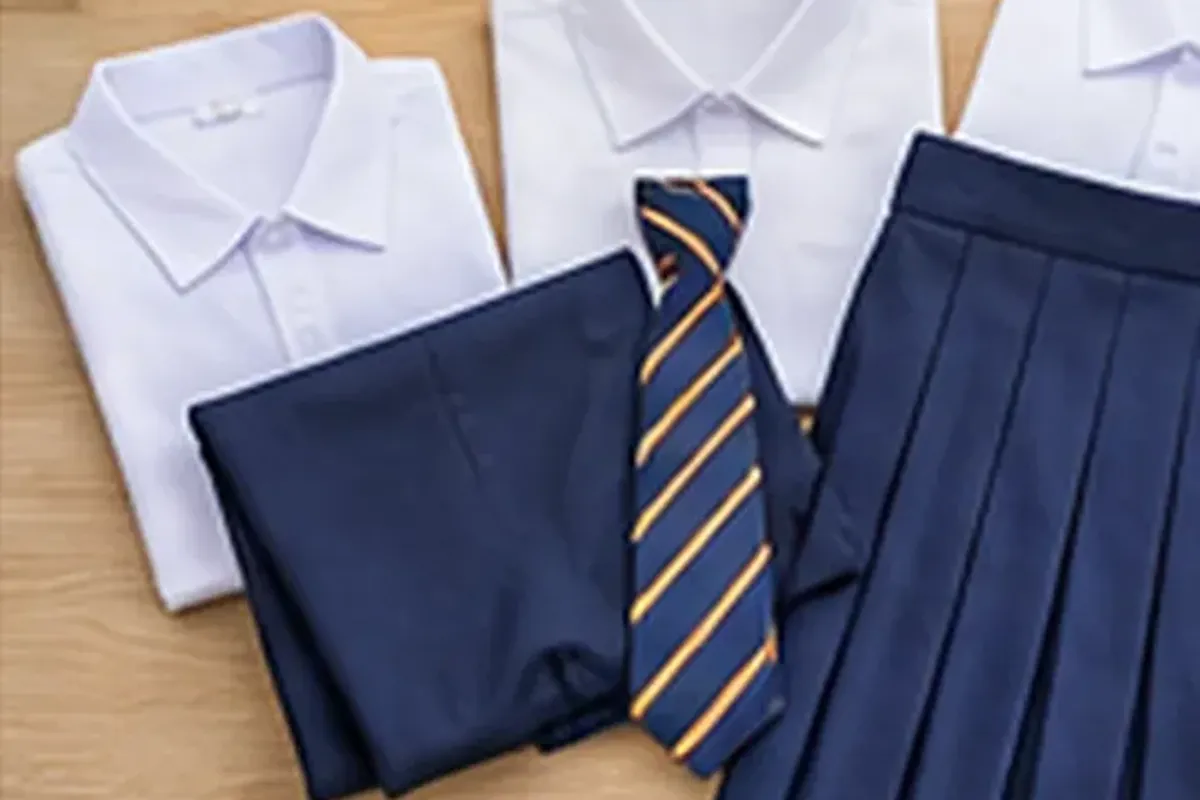
A thorough school skirt sample check covers five areas: the measurements against your size chart, the pleats or panels against your specification, the waistband and fastenings, the fabric and colour against your reference, and how the skirt behaves after a home wash. Approving the sample fixes all of these for bulk production, so the time spent checking it is time saved on every batch that follows.
The sample is the last point where changes are simple. After approval, it becomes the reference that bulk production and every reorder follow.
1. Measurements
Lay the skirt flat on a table and measure it against your size chart.
| Measurement | Where to take it | What to look for |
|---|---|---|
| Waist | Across the top of the waistband | Matches the chart; check stretched too if elastic |
| Hip | Across the skirt at the hip line | Enough room when seated |
| Length | Top of waistband to hem | Matches the chart for that size |
| Hem width | Across the hem, laid flat | Enough walking room |
| Waistband depth | Top to bottom edge of the band | As specified |
If you asked for more than one size to be sampled, check each one. Grading errors usually show in the smallest or largest size first.
2. Pleats and panels
For a pleated skirt, check:
- the pleat type and direction, from the front,
- the pleat count, front and back,
- the spacing and depth at the hip,
- the stitched-down length, and how the stitching is finished,
- that pleats fall straight and evenly when the skirt hangs.
For an A-line skirt, check the flare, the panel seams and that the hem hangs level all round. For a skort, check the panel style and that the inner shorts finish a little above the panel hem.
3. Waistband, zip and fastenings
- Open and close the zip several times: does it run smoothly?
- Fasten the button or hook: is it firm and well positioned?
- For an elastic back, stretch it: does it recover and lie flat?
- Look at the waistband: is it straight, with no twisting?
- Check the label: right position, right artwork, right care wording.
Try it on, if you can
A skirt that measures correctly can still sit oddly on a body. If possible, have a student in the sample size try it on, sit down, stand up and walk on stairs. Watch where the hem sits and whether the waistband stays in place.
4. Fabric and colour
Compare the sample with your fabric or colour reference in daylight and indoors. If the skirt must match a pinafore, trousers or blazer, place them together. For a check skirt, check the colours, the repeat size and how the check lines up at seams and pleats.
Our school skirts and skorts page lists the fabrics and colours we make skirts in.
5. A home wash test
Wash and dry the sample the way a family would, following the care label. Then check:
- The pleats are still in place, or press back easily
- The colour has not changed or run
- The waistband and elastic have kept their shape
- The hem lies flat and seams are intact
- Measurements are close to the original
This is the single most useful test for a skirt, because pleat behaviour after washing is the most common question from families.
Approving, or asking for changes
If everything is right, confirm the approval in writing. If something needs changing, list each change clearly, with measurements where possible. A small change may be approved from a photo; a bigger one usually needs a second sample.
Uniform shops approving skirts for their own label can read more about how we work on our page for uniform shops and retailers. We manufacture in India, and production starts only after you approve the sample. Ask us for a quotation, and plan time for the sample in your schedule.
Questions buyers ask
How many sizes should be sampled for a skirt?
One middle size is enough to check style, fabric and construction. Sampling the smallest and largest sizes too shows whether the grading works across your range, which is useful for a new pattern.
Can we keep the approved sample?
It helps to keep one approved skirt as your own reference. Sealed reference samples make it easy to compare bulk stock and reorders against exactly what was approved.
What if the colour is close but not exact?
Say so at the sample stage, with the reference attached. A shade adjustment is much easier before bulk fabric is made than after, so it is worth raising even a small difference.