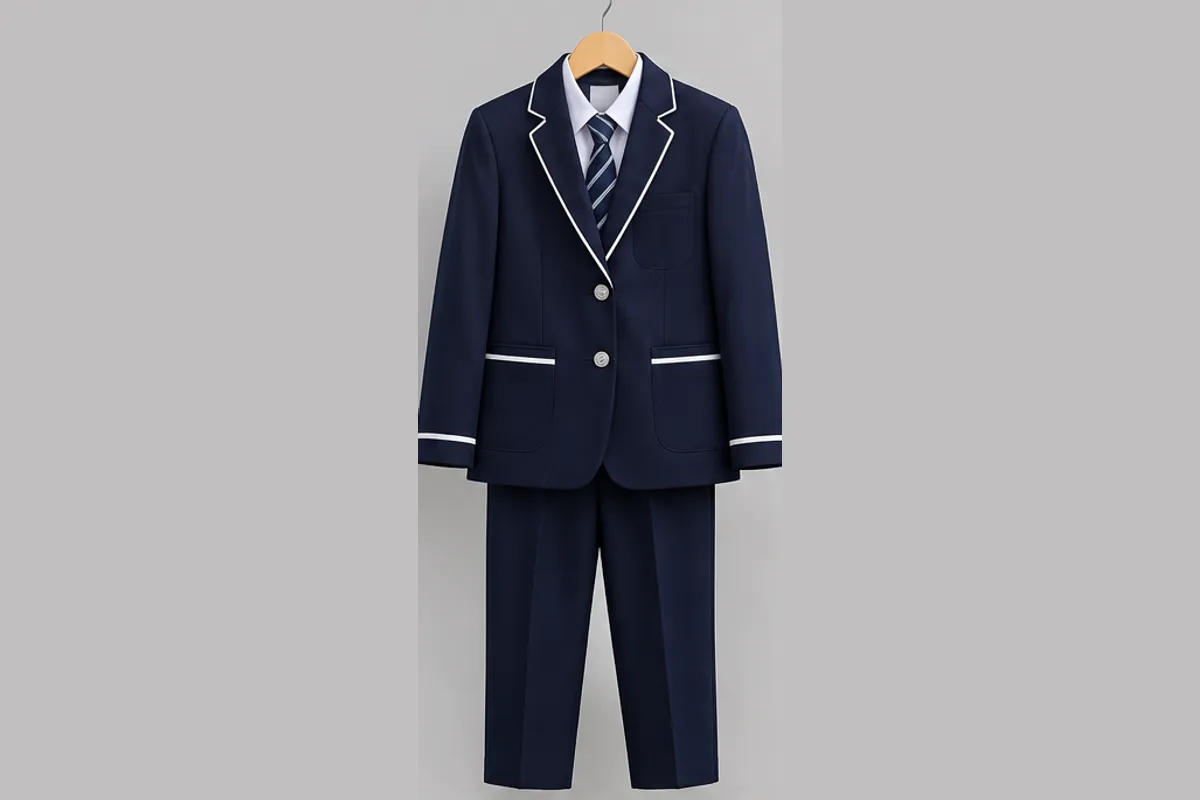
The difference between a boys’ and a girls’ school blazer is mostly in the pattern: the girls’ cut usually buttons right over left, has a shaped waist, a narrower shoulder and often a shorter body. Both can share the same cloth, braid and badge, so they look like one uniform while fitting two body shapes. Because each cut has its own pattern and size chart, they are treated as two separate styles when you order.
Schools adding a girls’ blazer for the first time, or replacing a unisex blazer that never quite fitted anyone, are the buyers who ask about this most. Here is how the two cuts differ and what you need to decide for each.
Where do the two patterns actually differ?
The visible details can be identical. The changes sit in the shape of the pieces and in a few fastening conventions.
| Feature | Boys’ blazer | Girls’ blazer |
|---|---|---|
| Button side | Buttons on the right front, fastening left over right | Usually buttons on the left front, fastening right over left |
| Body shape | Straighter side seams, little waist suppression | Darts or shaped seams to give a waist |
| Shoulder | Broader across the back | Narrower, with a smaller armhole |
| Length | Covers the seat in most sizes | Often a little shorter, sitting at the hip |
| Front buttons | Commonly two or three | Commonly one, two or three, as you choose |
| Pockets | Breast badge pocket and two lower pockets | Same, though some schools drop the lower flaps |
None of these is fixed. Some schools ask for the girls’ blazer to button the same way as the boys’, so the uniform reads as one design. Others want a longer girls’ body to sit well over a pleated skirt. Write the choice on your specification and it becomes part of the approved sample.
Should a school offer a unisex blazer instead?
A single unisex cut is simpler to stock. It suits junior years, where body shapes differ little, and it halves the number of styles a shop has to hold. The trade-off shows from around the early teens. A straight cut tends to pull across the hip on many girls and hang loose at the waist, so families size up and sleeves end up too long.
A common compromise is one cut for the junior range and two cuts from the senior years up. If you take that route, tell us at enquiry so the size charts link sensibly where the ranges meet. Size charts themselves are agreed for each order; how many sizes each range runs to is a separate conversation from the cut.
What stays the same across both cuts?
Keeping these identical is what makes two patterns look like one uniform:
- cloth and shade, matched to the same reference
- braid colours and positions, so the lapel and cuff trim line up visually
- badge size, thread colours and pocket position
- lining colour, whether the blazer is lined or half-lined, as specified
- buttons, so both cuts carry the same finish
We manufacture both cuts in India from the same cloth batch where the quantities allow, which helps the shade match between them. You approve a sample of each cut, ideally side by side, before bulk production begins.
How does a second cut change the order?
Each cut is its own style, and woven garments start at 50 pieces per style. A school ordering both therefore needs at least 50 of each, though sizes can be mixed freely within that number. Smaller schools sometimes find the girls’ quantity is the hard part. Options worth weighing:
- Order the girls’ cut for senior years only, where the fit difference matters most.
- Combine the order with a sister school that uses the same cloth and braid but a different badge, if a separate sew-on badge suits you both.
- Keep a unisex cut for now and plan the girls’ blazer for the next full order.
A uniform shop stocking blazers for several schools can also hold plain girls’ blazers in a core colour and badge them per school. Our page for uniform shops and retailers sets out how mixed orders like that are put together.
When you are ready, send the cut or cuts you want, a current blazer if you have one, and rough quantities by size. We will come back with a quotation for each style on our school blazers range, priced by fabric, quantity and branding.
Questions buyers ask
Can a girls’ blazer button the same way as a boys’ blazer?
Yes. The button side is a specification choice rather than a rule. Some schools prefer one fastening direction for every student, so the uniform looks identical in photographs. State it on the sheet and the sample will show it.
Is a girls’ blazer more expensive to make?
The shaping adds some sewing steps, but the price depends on cloth, quantity and branding as much as on the cut. Each style is quoted separately, so you can see both figures before deciding whether to offer two cuts.
Do the two cuts need separate badge artwork?
No. One artwork file serves both, as long as the badge pocket is a similar size on each. If the girls’ pocket is narrower in smaller sizes, we confirm whether the badge needs scaling when you see the samples.